Category Archives: Essays

‘I Am Love’ opens more than doorways

The month of January is named after Janus, the Roman god of exits and entrances.  Janus is most commonly depicted in ancient art as having two faces, one looking backwards while the other looks forward.  Janus is also symbolic of changes and transformations. The prospect of exiting and entering, of endings and new beginnings, and of personal evolution is the crucial theme, the essence, of Luca Guadagnino’s “I Am Love. 

The film begins with a prominent Italian patriarch entering through the front door of his stately villa. The lighting is gray and there is snow on the ground.  The camera frames the doorway from inside the villa and follows as he enters with regal grace. Through the open door, the snowy courtyard is visible. Various characters will cross the threshold of this doorway throughout the film. Some of these entrances and exits will be life-altering, and one climactic departure will be an exhilarating, if terrifying, flight of freedom—an exit from an old life and entrance into a new one.

The entirety of “I Am Love” is brimming with doorways being opened and shut.  The camera peers through doorways and into rooms; sometimes, multiple rooms are visible through two or three doorways simultaneously in a mirror-like effect. In the first quarter of the film, most of these doorways belong in the villa of the Recchi family, where wife and mother Emma Recchi (Tilda Swinton) spreads her maternal and wifely grace throughout the household.  As a transplant from Russia, Emma has humble origins, and hints of her status as an outsider still linger in her occasional need for solitude; she takes solace in the company of Ida, the house’s caretaker, and she often helps her with household tasks.

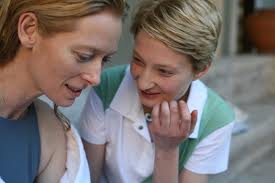
As the film progresses, the images of opening and closing, entering and exiting, become both more subtle and more obvious. An example of a subtle but momentous opening is Emma’s opening of a CD that she finds in the pocket of her son’s jacket.  Within this CD, she unfolds a postcard which contains a picture of a young woman.  The postcard is from Betta, Emma’s daughter, and written to her brother Edo.  Betta tells him that she is in love with another girl—the girl in the picture.  On the front of the postcard, in bold, black letters, is the word love. Emma’s inadvertent discovery of her daughter’s newfound sexuality is perhaps the defining moment for her in the film—Emma’s own personal re-awakening. I say re-awakening because Emma is content with her life; she is in no way repressed. It is Emma’s sense of general happiness and fulfillment which makes her eventual entrance into a new life that much more poignant—the only excuse for her transformation is love.

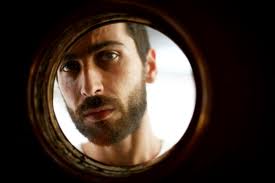
Emma’s newfound love is for Antonio, an innovative, rustic chef, and her son’s best friend. After essentially making love to him through ingesting his delectable cuisine (in a scene that is now referred to as “prawnography”), she and Antonio finally consummate their desire for each other at his secluded hill-top villa. After their tryst, Antonio has a vivid and impassioned fantasy about Emma; it begins with the camera peering through a brick entranceway which leads to a double-doorway that opens into his restaurant kitchen—another door-within-a-door image. There is a quick jump-cut to a door ajar though which sunlight from the street streams into the kitchen, then a cut to Antonio looking over his shoulder through the windows of the kitchen’s double-doors.  He peers through the circular window, sees nothing.  He opens the door and walks through to find Emma there, waiting for him.  She fervently drops her bags and they embrace and begin to make love. Antonio is jolted back to reality only when Edo walks through those very same doors.
With the overwhelming images of doorways within doorways, rooms opening into more rooms, it’s hard not to interpret this imagery as a metaphor for a Russian nesting doll—those little wooden dolls that continuously open up to reveal up to four smaller dolls inside, each decreasing in size. If you really want play the English-major’s-ridiculously-deep-analysis-game, Emma herself is an obvious metaphor for a Russian nesting doll.  As the film and her love for Antonio progresses, we see her break free of a multitude of outer-shells.  Emma begins as a loving, maternal mother and ideal Italian trophy-wife; but midway through the film, she transforms into an ardent lover whose Russian roots continuously begin to surface through her affair with Antonio. In fact, the foreplay of an almost ridiculously epic love scene (in which Emma and Antonio make love outside in the dirt among the creepy crawlies) has Antonio methodically undressing her, peeling back layer after layer of clothing until she stands before him completely naked and unadorned.  In this moment, Emma’s physical body becomes a means of expressing her opening up, her release. To prove I’m not pulling this Russian nesting doll theory out of my ass, the very next scene after Antonio’s kitchen sex fantasy shows Emma listening to Betta’s CD in her room, where, lo and behold, the camera strategically lingers on four Russian nesting dolls sitting on her desk.

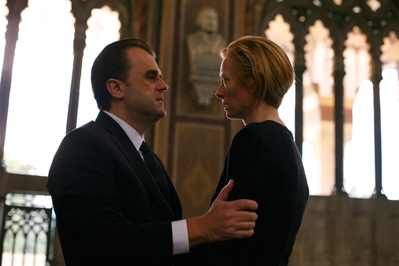
Near the end of the film, Emma’s love affair with Antonio is discovered by Edo, whose latent homo-erotic feelings for him become painfully clear. During a confrontation between Emma and Edo in which he disowns her as his mother, there is a freak accident, and Edo is killed. The last quarter of the film after Edo’s death is as sensational for its lack of dialogue as it is for the gruesome transformation of Tilda Swinton’s face; Emma’s once soft features disintegrate into a ghastly mask of pain. During Edo’s funeral, Emma walks as if in a trance into massive, empty cathedral, where, once inside, she stares through one of the many elaborately adorned doorways.  She also catches sight of a bird as it flies in an out of the open windows above her. It is here, among numerous doorways and windows where grey light filters through every open crevice into the cathedral, where Emma confesses her love for Antonio to her husband; it is her place of catharsis, among these open doorways, windows, and even ceiling.  Her husband coldly but rationally replies, “You don’t exist.” Emma does exist, but on a different plane from her previous life.
Until this point, the Recchi villa has been a place of closed doors and sealed shades; now, in the last, utterly breathtaking scene, we witness Emma making one last mad dash through the house before she makes her escape from her former life, wrenching open doors and bounding through them. As she heaves open her closet door, we have another stripping scene, as she, with the aid of Ida, tears off her mourning clothes, along with her jewelry and wedding ring—quite literally freeing herself from her previous existence. As Emma flees the household, she and Betta meet one last time, catching sight of each other through a large open doorway.  Emma and her daughter, who sparked her metamorphosis, exchange a speechless moment of mutual love, hands over their hearts, mirrors of one another.

In the film’s first shot of the villa’s main entrance, we saw a patriarch entering in the snow; in the last shot, we see the very same open doorway leading out into the lush, sunlit summer to which Emma has escaped. The doorway that framed a procession of patriarchal tradition has become the portal for a woman who is entering into her own transformation sparked by love unparallel to anything she has felt before—hence, the film’s unabashed titled.  “I Am Love” is singular proof that sometimes, doorways lead to much more than just another room.

‘4 Months, 3 Weeks and 2 Days’: Challenging Mise-en-scene

After viewing Cristian Mungiu’s utterly mesmerizing and criminally underappreciated “4 Months, 3 Weeks and 2 Days” I may finally understand the meaning, or at least one aspect, of the much debated term, mise-en-scène.  To explain my sudden realization I will focus on (with regret) only one scene, the first shot of the film, and analyze the crucial role that certain objects we see on screen will play within the film’s greater plot and theme.

The importance of a scene’s physical objects in film or theater is one element of the definition of mise-en-scène. This potentially elitist term is literally translated as “putting on stage,” depending on your source (thanks, Wikipedia!).  In my English undergrad days I learned that this definition can be interpreted as follows: everything you see before you on screen or stage will serve a purpose at some point in the play or film.  Hence, if there is a gun lying on the table, it will ultimately be fired. There is no gun on the table in the scene I am describing in Mungiu’s film; there is, however, a plastic tablecloth and a bizarre fish tank; two objects whose presence give new, haunting significance to the term mise-en-scène and its cousin, foreshadow.

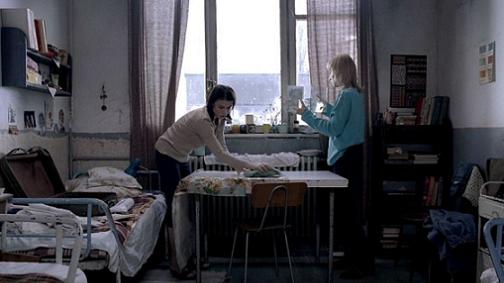
The first image in “4 Months, 3 Weeks and 2 Days” is a cluttered table.  Among the table-top objects is a tiny, ticking clock, an ash-tray with a still-smoking cigarette, a stack of what could be study notes, and an odd fish “bowl” which resembles something like a picture frame. Within this absurd aquarium, two orange fish swim in shallow water.  I smell a metaphor, don’t you?  We’ll get back to that later.

As the camera pulls away from the table, we first see a girl with dark hair and a fragile, innocent disposition sitting on a bed smoking a cigarette.  Her name is Gabita, and on this day, she is going to have an abortion.  As the camera’s vision widens a little more, we discover that there is another girl in the room with dirty blond hair who appears to be the more mature of the two, and also that both girls are in a college dorm room.  The blond roommate’s name is Otilia, and she is going to help Gabita arrange this abortion—which, by the way, is an illegal and extremely dangerous undertaking in 1987 Romania.  Once the two women are within our frame of view, they begin deliberately removing objects from the table, including the tablecloth itself.  Gabita wipes the tablecloth clean before folding it and placing it in an open suitcase on her bed.  The only object remaining on the now bare table is the odd fish tank.

Let’s start with the plastic tablecloth.  Following this first scene is a marvelous over-the-shoulder long shot of Otilia walking the corridors of her dormitory, running into friends and bartering items.  At one point during this take, someone yells to Otilia that Gabita’s father is coming for a visit.  Otilia relates this news to Gabita, who then removes the plastic tablecloth from her suitcase and meticulously spreads it back onto the table, as if she will be having a four course meal with her father.  We do not see Gabita return the tablecloth to the suitcase.

Later in the film, when Gabita and Otilia arrive at the hotel room where the abortion will be performed, they are joined by the “doctor” whom, in display of sick humor, is named “Mr. Bebe.”  It is here that the phrase “termination” is finally uttered.  Mr. Bebe coldly and pitilessly tells Gabita that she “will not require an anesthetic” because “the pain won’t be that serious.”  He then tells her that there could be serious bleeding, and “if you bleed all over the room, we’re in trouble. That’s what the plastic sheet was for.” And that’s what the tablecloth was for.  “Left it in the dorm,” Gabita shamefully admits.  It is a sad and hopeless day when the purpose of a plastic, flower-print tablecloth is to catch the stains of abortion.  It is an even sadder day when said tablecloth is forgotten.

What is innovative about Mr. Mungiu’s use of the tablecloth is that he is challenging one of the key tenets of classical mise-en-scène.  Although it adds to the plot’s mystery and suspense, the tablecloth itself is never actually used. This whole aspect of what is absent, what’s not “put on the stage,” is part of the film’s brilliance.  This isn’t to say that Mr. Mungiu is necessarily a minimalist.  He shows us plenty.  The unblinking long takes of Mr. Bebe inserting the probe into Gabita, and the nearly indiscernible aborted fetus lying in a plastic bag on the hotel bathroom floor are brutally graphic in their unfettered realism.  But even more haunting is what Mungiu hides from the viewer.  For one, although he shows us the dead fetus, he does not show us Gabita’s actual abortion.  Instead, his camera follows Otilia to her boyfriend’s house.  While Otilia is painfully sitting through her boyfriend’s mother’s birthday dinner, we can only begin to imagine the utter solitude, the tension and the terror of Gabita’s ordeal.  Likewise, when Mr. Bebe forces Gabita and Otilia into momentary prostitution in return for his services, we do not see the sex.  Rather, Mr. Mungiu keeps the camera in the hotel bathroom as each woman waits their turn.  Both women’s reactions in the bathroom—Otilia coldly and mechanically washes herself, Gabita quietly sobs before doing the same—are enough to convey their utter shame and disgust.  Thus, “4 Months, 3 Weeks, 2 Days” is something of a paradox.  It is a film that gets under our skin thanks to its decidedly jarring images, but it is ultimately what we don’t see that haunts us long after the final credits.

But what about that fish tank?  When Otilia and Gabita are in their dorm room early in the film, Gabita tells Otilia to remind “Daniella” to feed the fish, to which Otilia replies, “They’ll be fine without food for two days.”  Fast forward to the last shot of the film, which finds both women in a hotel restaurant.  Gabita explains to Otilia, who is upset with Gabita for leaving the hotel room, that she left because she was “starving.”  The film ends with Otilia looking hopelessly out the restaurant window while Gabita carefully reads the dinner menu.  We don’t need to have the fish tank sitting on the table alongside these women to realize that they too are trapped in shallow water, drowning.


‘Splice’: What I learned about audience reactions

“Splice,” the new film by Canadian director Vincenzo Natali, is a revitalizing standout in the long-suffering genre of sci-fi/horror.

Instead of veering into predictable B-movie, torture-porn tendencies, “Splice” is a serious, insightful commentary on scientific and human ethics.  It is also self-effacing, ghoulishly funny, and fearless in its willingness to be shocking and thought-provoking without insulting its audience.  Having said that, there are ten minutes in the film walk this fine line  without falling over the edge: a sex scene between Clive (Adrien Brody) and Dren (Delphine Chaneac), a humanoid clone.  This particular scene caused a raucous uproar among viewers when I saw it in the theater, a reaction which I believed was both inappropriate and illuminating.

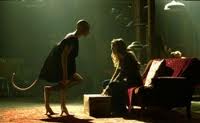
Some brief background before delving into this infamous scene: Dren is the creation of Elsa (Sarah Polley) and Clive (Mr. Brody), who are scientific partners as well as lovers.  An experiment in mixing human and animal DNA to create a kind of amphibious, avian hybrid, Dren also has the ability to rapidly age; as a result, she has all of the features of a fully developed female midway through the film.  Needless to say, despite (or perhaps, because) of her strange, alien characteristics, which include a bald head, a tail, and wings, she is exotically beautiful.  Apparently in her late-teenage stage, Dren has been crushing on Clive, drawing and hiding pictures of him, etc.  Likewise, Clive has begun to show kindness and a hint of playful, innocent flirtatiousness towards Dren, especially after Elsa’s maternal nature is gradually replaced by calculating, cold cruelty.

This pre-existing sexual tension between Clive and the blossoming Dren, as it culminates with Elsa’s increasing heartlessness, peaks when Dren and Clive are alone in a barn.  The seduction and sex which follows is in no way violent or cheaply graphic.  Aside from the obvious fact that Clive is betraying Elsa, his lovemaking with Dren is actually quite innocent. Although Clive is  clearly reluctant, he also feels the need, perhaps out of guilt, to show Dren, who has a tragically short lifespan, the pleasures of a sexual experience.  A more apparent interpretation which proves that this sexual encounter is more than a grade B movie spectacle is that it unearths deep, intricate aspects of Clive’s character.  Throughout the film, it is suggested that Clive is the submissive and Elsa the dominant in their relationship, a dynamic which may hint that although he is an accomplished scientist, Clive still worries that he is nothing more than an overgrown nerd.  Thus, his impulsive, impassioned sex with Dren makes him feel empowered and sexy, (perhaps for the first time in his life,) while also being an ideal and intimate scientific discovery.

It is understandably awkward when watching any sex scene in a movie theater.  But when the audience collectively laughed, groaned, and shouted “That’s so fucked up, man!” during this scene—a scene which reveals so much about the complexities of human desire–my theater-going experience was essentially ruined.  Their reactions made me more uncomfortable than the sex itself. As previously stated, the scene was not kinky at all; yet, in a matter of minutes, I felt very low, even ashamed, like I was sitting in an adult theater watching some x-rated detritus of a film. This furor went on for so long, even after the scene was over, that I seriously considered  walking out and waiting for the DVD release.   I feared this audience uproar had tainted the film for me; that they had stripped “Splice” of its artistic, at times inspired, intentions, and I would always associate the film with the petty, tactless reactions of these spectators.

This unpleasant incident was uncannily similar to what happened when I saw Ang Lee’s “Brokeback Mountain.”   It is of consequence to mention that I saw this film in a much smaller theater in a distinctly liberal town in upstate New York.  The viewing was going well, even through the jarringly rough sex scene between Mr. Ledger and Mr. Glyenhaall in the first half of the film. Oddly enough, the moment which provoked the unseemly audience reaction involved no gay sex.  Rather, it was when Ennis (Mr. Ledger) and Jack (Mr. Glyenhaall) are reunited after years apart and share a spontaneous, fervent kiss, which Ennis’ wife, Alma (Michelle Williams), espies through her kitchen window.  Even in a theater filled with what I would venture to call hippies, this agonizing moment of realization, so poignantly expressed through the horrified shock on Ms. Williams’ face, was littered with chuckles, obscenities, and exclamations like, “BUSTED!!”  As during “Splice,” I was both disgusted and upset by these crude responses, perhaps even more so because of the latent homophobia it revealed in a so-called “progressive” audience.  Yes, both the kiss and its subsequent exposure to Alma’s unassuming eyes was unexpected, but it would have been a relief to hear gasps of shock and surprise rather than hoots and giggles.  It reduced an emotional turning point in the film into a shallow and primitive “gotchya!” moment.

After much debate over my second experience with rude and rowdy audience during “Splice,” I decided it was not fair to judge them.  When we are unsure how to react to certain situations, such as scenes in a film, our discomfort may indicate that some aspect of the film evoked something in us we’re afraid or embarrassed to confront or acknowledge. I am in no way suggesting that the people who snickered during “Brokeback Mountain” are still in the closet; nor do I believe that the boorish crowd in “Splice” had a secret fantasy to make love with a humanoid, though beautiful, clone (although the males who were hollering were perhaps trying to conceal the fact that they were pretty aroused themselves).   What I do believe is that when moments in film, or any artistic medium, instill discomfort within the viewer, that it says something about the quality, intellect, and imaginative power of the work of art.

It is not news that films that evoke a strong emotional reaction from the audience are either catastrophically offensive or artistically provocative. I think that “Splice,” for its science-fiction- turned-reality reality premise, along with “Brokeback Mountain’s” re-definition of the cinematic love story, definitely fall into the latter category. So, theatergoers, I encourage you to react.  Let it out–your hollers, guffaws, everything. It will give me something to rant about.  More importantly, it will let me know whether the film is breathtakingly bad, ingeniously inspired, or striving to uncover some suppressed aspect of ourselves by stimulating emotions we have yet to feel.


‘Antichrist’: Into the woods

As Lar’s Von Trier’s “Antichrist” arrives on DVD, I felt compelled give the film a second viewing. What I found was this: despite the overwhelming controversy surrounding the film’s gratuitous sexual violence, the most troubling, terrifying moments in “Antichrist” were essentially sexless and bloodless. And talking fox-less.

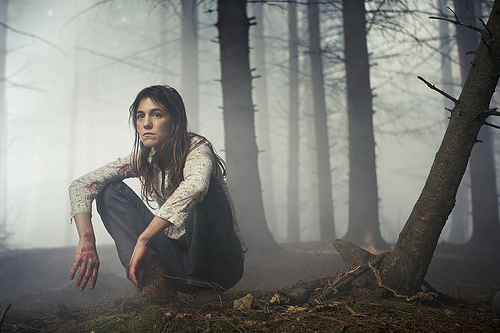
I realized that much of “Antichrist’s” terror stems from Mr. Von Trier’s use of the woods as a representation of paranoia, anxiety, and dread of the natural world. The first image we see of the woods is when He (Willem Dafoe) and She (a mesmerizing Charlotte Gainsbourg) are still in the drab but nevertheless safe surroundings of their apartment. After She accuses He of indifference towards their son’s death, the scene shifts from their bedroom to a starkly black and white image of a wooded area. There is no music, but a sinister, restrained roaring noise, as if the woods are seething. The color is so contrasted that it looks more like a painting then actual woods. The trees and bramble are bone-white and skeletal, jutting out from the underbrush like the claws of some indiscernible but omnipotent beast. Some branches are shaped like arches, almost as if they are portals to a parallel state of reality where, as She later asserts, “nature is Satan’s church.”

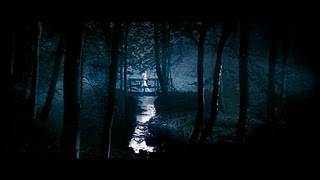
Likewise, the eerie white glow of the branches is also illuminates Ms. Gainsbourg when, almost like a macabre fairy tale, She is shown in a dream-like sequence, in extreme slow motion, walking over a wooded bridge. It is a long shot from above, and her figure is glowing in an incandescent, ghostly white in contrast to the gray and rust colored wood. What is most unsettling about this shot is that we can clearly see her figure from afar, and that She is gazing straight at us. Yet, her face and eyes are slightly blurred, giving the viewer the impression that she can see us, but we cannot see her, instilling the feeling of being watched by some unknown and indiscernible entity. The image is at once breathtakingly beautiful and chilling.

In another scene which similarly draws on the claustrophobic terror of the woods, He (Willem Dafoe) is attempting to guide She through her fear of the natural surroundings with a “game,” wherein She must walk from one stone to another through several feat of grass. Her bare feet exposed to the long, overgrown grass, again shot in slow motion, gives the sense that each moment the bare foot is exposed to the earth is one of profound vulnerability. The simple, rational action of walking on grass is no longer safe, and any rational thoughts about nature and the woods we’ve been clinging to thus far are slowing disintegrating.

The penultimate moment of these disturbing scenes in the woods is She’s flashback of hearing what she believes is the sound of a crying baby. At first, the wailing sound is distinctly human, but there are certain moments when the crying has an animalistic, bestial edge; the beginning and end cadence of the cries sound more like snarls, and we are unsure as to whether nor not She is hearing the sound of  a child, her child, or whether it is the howl of some fabled, terrible  beast. The most unnerving part of this scene is when, after searching all over the perimeter of cabin for her son, she finds him blithely playing in the shed.  In a conventional horror film, this would be the moment when the crying, imaginary, psychological, whatever, would cease: “Tah da! Just my mind playing tricks on me! My child is safe and sound, I must just be paranoid!” But not this time. As She stares right into her child’s face, who gives her a somewhat chilling, toothy grin right on cue, the howling continues. There is a close up on She’s stunned face; then, the camera drifts up, up, until we see the vast expanse of the deep woods, which itself may be the origin of the incessant, infinite wailing.

I admit that I do admire Mr. Von Trier as well as Mr. Dafoe, and especially Ms. Gainsbourg, for their artistic fearlessness and audacity.  However, I ultimately feel that the film would have benefited from more use of the woods as an expression of this extreme grief and depression rather than the literal mutilation which occurs. For instance, the scene where He crawls into the foxhole, of which the shape is distinctly yonic (female phallus–yup, there’s a word for that!), and She frenetically stabs and tears at the dirt in desperate effort to unearth him, has violent sexual undertones which could have easily and artfully replaced the extreme sexual violence that ensues.

Using the wild, arcane, and dangerous elements of the woods as a representation/expression of  the “grief, pain, and despair” that She feels may have been the more imaginative and tactful choice. But then perhaps, the disquieting, subtle moments detailed above would not be as effective if not juxtaposed with the film’s more physically ferocious moments. I personally am mesmerized by films that have those wild, outrageous moments, when you’re staring, (or forcing yourself to look away) from the screen in awed disbelief. That’s what “Antichrist” was for me: a film that took you to the edge while also maintaining moments of quiet, understated power.


‘The Departed’: Little Miss Freud

Looking for women of substance in Scorsese’s “The Departed?” 

Oh, there is one.  You just have to find her hiding underneath the sea of seething state-troopahs, cell-phone chimes, cocaine operas, and micro-prawcessahs.

Manohla Dargis of the New York Times wrote that “most of the finest American directors working now make little on-screen time for women.”   I couldn’t agree more. I also think that in the meantime, it’s up to us to be a perceptive audience and unearth the  value and nuance in female characters in films which are dominated by burley males with guns and identity crises.

Multifaceted women are scarce in Martin Scorsese’s “The Departed,” but there is one worth our while.  Madolyn, the “police shrink,”  is played with considerable depth, intelligence, and intrigue by Vera Farmiga.  Fine acting aside, if we take a very close look at Maddy’s role as it relates to other characters as well as to the film’s plot and theme, she may indeed be (streeeeeeetch) the most powerful and insightful character in the film.

Little Miss Freud
Let’s consider some less obvious manifestations of Madolyn’s power. For one, she is the only character aware of Sullivan’s (Matt Damon) impotence.  Being a therapist, she casually assures Sullivan that it’s a “common” problem for men–while suggestively (perhaps mockingly?) peeling a banana.  This knowledge secures her sexual prowess over Sullivan.  Maddy knows full well that his cock is indeed not “workin’ ovah-time.”

Consider the scene where Sullivan receives the phone call from Costello (Jack Nicholson) while Maddy is moving her things into his apartment.  This scene revolves around how Madolyn observes and scrutinizes Sullivan. There are numerous instances where her eyes linger searchingly on Sullivan as he goes about his morning routine (wherein he does display a hint of innocuous sexism, such as forcing Maddy to hide childhood pictures, making her answer the phone, etc).  We, the perceptive audience, notices these sidelong, intuitive glances; Sullivan obviously does not.

In the same scene, Madolyn answers a phone call from Costello and blithely believes that the voice distortion belongs to a “cancer guy.” This reveals her utter ignorance and detachment from the organized crime sphere.  Yet, she nevertheless looks at Sullivan with more doubt, suspicion, and curiosity in the twenty minutes before and after this phone call than any of the trained detectives surrounding him at the police force.  Later in the film, during the micro-prawcessah raid scene, we’re convinced that Queenan (Martin Sheet) is going to catch Sullivan in the act.  Instead Queenan hands Sullivan the entire operation.  Madolyn evidently sees something unsettling in Sullivan that these so-called “detectives” cannot.   After all, she is “little Ms. Freud.

You Know Who I Am
Unlike Sullivan and Costigan (Leonardo DiCaprio), Maddy retains her sense of self because she is not forced to hide her identity.  In this sense, she holds more power within because, unlike her lead male counterparts, she does not live in perpetual fear of being discovered.  Sullivan’s identity crisis worsens when he kills Costello after realizing that that he’s an FBI informant; at this stage, he can’t even distinguish himself Costello’s rat.  On the other hand, undercover troopah Costigan grasps desperately to childhood pictures, the only material proof of his true identity which he chooses to relinquish for the call of duty.  Madolyn, however, displays pictures from her childhood in her apartment, which pleases Costigan (to Maddy’s delight) because he finds solace in her ability to unabashedly display her identity.

The most obvious source of Madolyn’s power is her underlying connection between Sullivan and Costigan—she is dually Sullivan’s “serious” girl-friend and Costigan’s therapist-turned-secret-lover. It is this connection that gives her the broadest perspective and knowledge of any character in the film, because at one point, she is the only character who knows, simultaneously, that Sullivan is the rat and Costigan is the undercover troopah.  This moment arrives when Costigan sends Sullivan recordings between him and Costello as a threat; Madolyn sees Costigan’s name on the return address, puts two and two together, and plays the tapes.  In a wonderfully refreshing scene, Madolyn does not wilt in fear when she hears the recordings of her future husband cavorting with Boston’s crime lord; nor does she flee with the evidence.  Instead, she looks Sullivan in the eye and yanks out the earphone plug, allowing his lies and secrets to pervade the entire room.

Lastly, we must not forget that Madolyn becomes the only person Costigan can trust after Queenan’s death and Dignam’s (Mark Wahlberg) “leave of absence.”  Costigan therefore leaves her an envelope containing what I assume to be documents revealing his true identity, as well as proof that Sullivan is Costello’s rat.  Madolyn now holds the absolute power in the film—the ability to bring a sense of justice and closure to a story where justice seemes unattainable; where the good-guys suffer senseless deaths while the villain would go undiscovered and unpunished.  How do you think Dignam found out that Sullivan was the rat?  Ultimately, we have Madolyn to thank for the film’s surprise and satisfying ending.  Thanks, Maddy!

All that murderin’ and fuckin’ and no sons?

Costigan is clearly the film’s protagonist and hero.   His desire to shed his criminal persona and regain his identity must be fulfilled for there to be a sense of resolution in the film.  Madolyn carries Costigan’s blood and identity by bearing his child.  She is the only character with the power to start a new life for herself and fulfill Costigan’s wish of regaining his name and identity through a son.  Motherhood may not be the most feminist path for Madolyn, but remember, this is a Scorsese film—at least she wasn’t the butt any madcap knife-throwing shenanigans.

One last note to Scorsese, P.T. Anderson, and the Coen brothers: you guys are awesome and “O Brother, Where Art Thou” is a gem, but finding the worth of a female character in an Oscar- winning film should not have to be this hard.

And one more time, for shits and giggles: MICRO-PRAWCESSAHS.


‘Children of Men’: The shot and the sea

The Shot

There is a moment in the film “Children of Men” that is referred to simply as “the shot” by film critics and students alike.  For those of you who, like me, are not film elitists, “the shot” is director Alfonso Cuaron’s ten-minute long single tracking shot where the camera trails Theo as he staggers through a hellish, war-ravaged city street in search of Kee and the child. As the scene reaches its denouement, the camera lens is spattered with blood, yet still reflects, unblinking, the surrounding carnage, like a corpse that died with its eyes open. It is a mesmerizing, visceral scene which shadows Theo’s every glance and head-turn.  It is one of the few moments in the film where the audience fuses with Theo through a shared point of view.  This is “the shot.”

No, I am not a Cinemaphile.

When I first saw “Children of Men” in theaters, there was one scene that haunted me for weeks after, and it was not the shot described above.  I was and remain ignorant of film student vernacular and culture, so when I overheard cinema hipsters buzzing about the “the shot,” I naturally thought that my shot and their shot were one in the same.

[Cinemaphile]:  “You see ‘Children of Men’?”

[Me]:  Yeah.

[Cinema Hipster glares at me knowingly

and shakes head slowly from side to side, dumbstruck]:

[Cinema Hipster]:  “the fucking shot, man…”

[Me, in the know]: “I know.”

Apparently, I did not know.  My scene and the cinema hipster’s shot were indeed not the same.  For me, there is only one scene in “Children of Men” worth referring to as “the shot.”  I will refer to this shot as “The Sea,” and it plays as follows:

 My Shot, or The Sea: Why it is Important, and Why it is better than Your Shot, Cinema Hipster

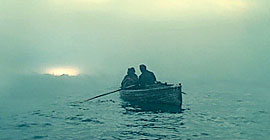
 The end of the film.  Theo, Kee, and the newborn are led to a dingy floating in a water tunnel that leads to the sea.  There is a halo of light within the otherwise dark tunnel which illuminates them and follows them out until they reach the exit.  Once they are out in open water, the atmosphere feels strangely claustrophobic.  Although they have escaped the imminent menace of the shore, they are encircled by thick, white fog and endless ocean on all sides.  Kee and the child sit facing Theo, whom is rowing the lifeboat.  They are seeking the vessel “Tomorrow,” alone in the middle of the sea, shrouded in mist, no help or living thing within sight.  The chaos of the city streets would almost seem a relief to the eerie isolation of their current surroundings.  At this moment, the threesome is most vulnerable.  Smothered by fog and endless ocean, they sway precariously in the swells, waiting.

Focus is now on the three passengers.  Kee, spotting blood on the boat’s floor, has a freak-out, believing the blood to be her own.  Theo reassures her that it is his own blood, and smiles.  “They got me,” he says, like a soldier wounded in battle.  But his smile is laced with the irony of a man who is about to die an inglorious death on a dingy in the middle of the ocean.

The child begins to cry.  Kee, having been a mother for less than a day, is unsure of how to hold and comfort her child.  Unexpectedly, Theo’s paternal instincts surface.  He pantomimes the act of holding a newborn to guide Kee.  There is a faraway, distant shot of the boat, and the threesome appear to be barely visible blurs in the mist.  Even so, Theo’s movements are unmistakable; he is embracing and gently rocking a phantom child in his empty arms.  Kee mimics his movements.  The child, soothed, is quiet and still.

“Dylan,” Kee says.  “I will name the baby Dylan.  It is a girl’s name, too.”  Theo smiles at this, slumps over, and closes his eyes.  He could be dead.  Or he could be sleeping.  Nevertheless, the few seconds that follow are the most hopeless and dismal of the entire film.  Without Theo, Kee realizes that she and her baby are utterly alone in the middle of the sea.  Suddenly, Kee sees the rescue vessel, “The Tomorrow” as it approaches, and attempts, unsuccessfully, to rouse Theo from his stupor.  Man, woman, and child await the ship amidst the trembling undulations of the sea.  There is a haunting, operatic soprano’s voice that sings the film’s reoccurring theme.  The screen cuts suddenly to black, with the words “Children of Men” branded across in stark white letters.  The end.

Days after watching “Children of Men,” I was thoroughly depressed by the ending.  I found myself dwelling on this last image; the bleakness and solitude of the sea, and the three souls, alone, their last hopes lying with naught but a rusty ship. Then I remembered the child’s name.  Dylan.  Yes, Dylan is a girl’s name, and it is also the name of Theo’s dead son.  Translated from its Gaelic origins, Dylan means “of the sea.”  I remembered that in the film, Theo taught his son, Dylan, how to swim when he was two months old.  And, being an English major who has nothing better to think about, I remembered the last lines of a cherished Dylan Thomas poem:

“Time held me green and dying

Though I sang in my chains like the sea.”

 I thought about those lines.  I thought about the human race as it is presented in the film; a species approaching extinction, on its last legs; a populace that is alarmingly similar to our own.  I thought about how the child’s name signifies one of the few places left on earth that humans are unable to inhabit, due to lack of fins and gills.  And yet here she is, in the middle of the sea.  Dylan.  And in this moment, there is not a body around to corrupt her spirit, save her teenage mother and a man who is still holding onto his own dead child, either in his dreams or in another life.  This scene is important because it is simultaneously hopeless and hopeful.  It presents us with ourselves, dying, and then being born again in a place where, until now, human life has yet to thrive: the sea.  And so, Cinema Hipster: that is why my shot is better than your shot.