Category Archives: Unconventional Love Stories

Unconventional Love Stories series: ‘Head-On’

“Head-On”: Cahit and Sibel
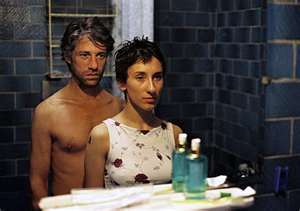
An arranged marriage like no other. Cahit and Sibel meet in a rehab center—he for driving drunk head-on into a cement wall, she for slitting her wrists. Sibel is desperate to marry a Turkish man to appease her traditional Turkish parents and escape from a repressive and often abusive household. Sibel sees the self-destructive, freewheeling Cahit as the perfect match.  He’s Turkish and not looking for any kind of romance or commitment, which will enable Sibel “to live and to dance and to fuck. And not just with one guy.” Sibel proposes this marital “façade” to Cahit, who, after some earnest “what the fuck are you thinking” retorts, accepts Sibel’s proposal. Hence begins one of the most tumultuous, intricate and visceral romances depicted in current cinema.

As husband and wife, Cahit is at first intrigued by –Sibel’s uninhibited sexuality—not towards him, but towards men that Sibel seduces. Cahit’s infatuation grows into jealously as he is left alone in clubs while Sibel “gets laid.” Jealousy grows into protectiveness, and eventually Cahit begins to feel desire and genuine love. Cahit and Sibel’s “marriage” is not sexual, so Cahit’s desire awakens through small intimate gestures, like when Sibel cuts his hair and cooks him a traditional Turkish dinner. We know that Cahit’s a goner when he removes Sibel’s clothes from the hangers, breathes in their scent, and sleeps with them. It is a touching moment, considering Cahit’s coarse exterior.

For me, the most unconventional aspect of Cahit and Sibel’s relationship is how they begin to express their love for each other.  Cahit, in  a love-and-alcohol induced swoon, ecstatically slams both his hands down on a bar table, breaking glasses and bloodying his hands. Oblivious to the pain, he joins the torrent of dancers, raising his arms, dripping blood, over his head and eventually climbing onto the stage in a kind of euphoric victory dance. When Sibel and Cahit are forced apart by circumstances that I refuse to spoil, Sibel cuts her hair boy-short, wears baggy, shapeless clothes and essentially embodies Cahit’s heedless lifestyle. It’s as if the only way she can survive Cahit’s absence is if she becomes him.

The best clip I could find was a mediocre trailer for the film, but at least it gives a pretty clear explanation of the plot. And the Wendy Rene song at the end, “After Laughter (Comes Tears),” gets me every time.

Unconventional Love Stories series: ‘The Piano’

“The Piano”: Ada , Baines and the piano

I first saw bits and pieces of Jane Campion’s “The Piano” when I was very young, maybe ten or eleven. I remember watching the film and wondering, “Why does this man have tattoos on his face?” and “Why is he dusting this piano with his shirt….in the nude?” I recently watched the film in its entirety, and my goodness—it still deserves every bit of praise it received when it was first released in 1993. “The Piano’s” themes, visual beauty and dark humor (yes, it’s funny!) are not in the least bit dated. But I digress. Back to the bizarre love triangle.

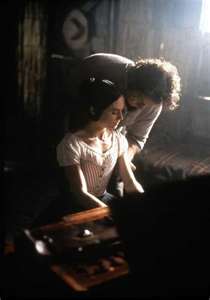
Ada, the mute (by choice), austere and sometimes irascible central character, is in love with her piano. Arriving to New Zealand from her native Scotland, she is no less than a mail-order bride for Stewart, a self-conscious and mundane plantation owner. Baines, Stewart’s friend and sometimes business partner, is at once intrigued and mystified by Ada. Like Ada, Baines too is an outsider; a former Scotland native, he has tribal Maori tattoo markings on his face and has adapted to the Maori culture. After Baines sees Ada literally come alive with joy and passion while playing her piano, he views the piano itself as an opportunity to get closer to Ada. Baines buys the piano and uses it as a contrivance—a pimp, if you will—to bring him and Ada together, as she reluctantly agrees to give him piano lessons at his home. To Ada’s surprise, Baines has no interest in playing himself, and only wants to watch her play. Unable to control his arousal during one of the first “lessons,”  Baines abruptly kisses Ada’s neck while she is playing and reveals to Ada that there are things  he’d “like to do” to her while she plays. Ada is shocked and disgusted, until Baines asks her if she knows how to bargain. He proposes that Ada  “earn” her piano back from him, key by (black) key; that is, each erotic favor Ada allows him is worth the amount of black keys she feels is appropriate.  Caressing her arm while she plays is worth two keys; lying together, naked, is worth ten keys—you get the idea.

I was quite surprised at this plot development because I already knew that Ada and Baines were the romantic center of the film, and I did not expect Baines to force her into something close to prostitution as a prelude to their romance. Yet, as brutish and crude as Baines’ initial “bargain” may appear, his actual erotic advances towards Ada are surprisingly cautious and even tender. During one lesson, Baines asks Ada to lift her skirt higher and higher as he lies on his back underneath the piano bench for an unimpeded view. But instead of the expected groping, his eyes follow her feet as they press on the pedals, and his fingers trace a tiny circle of exposed skin on her leg from a hole in her stocking. Ada, at first prude and aloof towards Baines, slowly becomes intrigued and obsessed with his uncouth and reckless romanticism. Yes, she wants her piano back, but she eventually wants him as well—an eccentric courtship for two very eccentric lovers.

This is a stunning scene which illustrates the unique love triangle between Ada, Baines and the piano. Ada plays the piano while Baines rests his hands on it, feeling its vibrations.  Baines then stares longingly at the  player-less piano, envisioning Ada’s undulating form as it surges and swells over the keys. Unfortunately, the clip ends just before he cleans the piano in the nude with his shirt.


Unconventional Love Stories series: ‘Boys Don’t Cry’

I’m normally not one for lists, but I thought it would be an interesting change to do a short series of my favorite unconventional love stories in film. Each post will be a brief description of a love story in a film and how that love story is extraordinary,  or even unseen, existing beneath subtle layers. I think the love story in my first film, Kimberly Peirce’s “Boys Don’t Cry,” falls into this latter category.

“Boys Don’t Cry”: John Lotter and Brandon Teena

The homoerotic relationship between the transgender Brandon Teena and John Lotter, Lana’s obsessive and frighteningly over-protective ex-boyfriend, is insightfully conveyed through the nuanced eye of director Kimberly Peirce. Brandon initially idolizes John, seeing him as his guide into his new male identity; if Brandon can hold his own alongside John’s ferocious masculinity, he can truly become Brandon. John Lotter’s endearing perception of Brandon as a precocious, often hapless kid brother eventually turns into bewilderment and jealousy. Brandon becomes an object of endless scrutiny for John, who is desperately trying to figure out why Lana chose this slight, effeminate newcomer over him.

The most erotically charged moment between John and Brandon is when Brandon is blindly driving—more like recklessly speeding—through a dust cloud on a dark Nebraska highway. The film actually begins with a short clip of this moment, because this is Brandon’s ultimate masculine fantasy. Brandon is tentative at first, but is provoked by John, who is sitting, suggestively, directly behind Brandon in the car. This scene in the car is a unique encapsulation of the love triangle between Brandon, John and Lana: Brandon is trying to impress Lana with his reckless masculinity behind the wheel, while John is attempting to maintain his role as alpha-male by expressing his sexual dominance over both Lana and Brandon.  At one point, John leans forward into Brandon from behind, their heads almost touching, and whispers driving directions as he squeezes Brandon’s shoulder. If the dialogue were muted, it would appear as though John was whispering sweet nothings into Brandon’s ear. Brandon presses the gas and revs through the dust, and John slouches into the back seat, clearly experiencing some kind of ecstatic/sexual release, either from the high of the car chase or from the erotic dominant/submissive interplay between himself and Brandon. For the driving-dust-cloud scene described above, fast-foward the below video to 5:51. Or watch the entire clip, which includes one of my favorite lines from Brandon as he checks his good looks in the mirror.

Next up, Ada and Baines in “The Piano.”