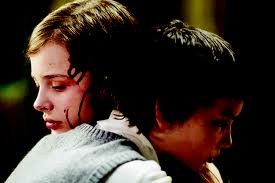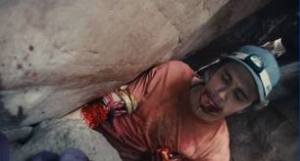
‘Take Shelter’

Haunting, unsettling, terrifying, anxiety-inducing—you name the adjective and it’s been used to describe Jeff Nichols modern day apocalyptical masterpiece, “Take Shelter.” So what more is there to say? “Take Shelter” is indeed all of the above, and the brilliance of the film is that it is so understated that you don’t realize or understand its impact until it has had time to settle under your skin and into your psyche.

It is always a challenge to watch a movie in which the expectations have already been set sky high. Oftentimes, when experiencing any art form that has garnered a wealth of critical praise, I find that I am forcing myself to feel certain emotions and be moved in some meaningful way by the art. The feeling is not genuine, but rather what I think I am expected to feel. This does not happen often, but it is extremely disappointing when it does. And to be honest, I was forcing myself to feel unsettled and disturbed early on in “Take Shelter,” when the images of Curtis’ (Michael Shannon) nightmares begin to unfold. I had read so many articles describing the eeriness of these dreamlike events that I felt desensitized to them; the ribbon-like formations of the birds, the churning black clouds, the rust-colored rain. I was on the verge of a glorious let-down when a tall drink of water and force of nature that surpasses the portentous storm named Michael Shannon pulled me out of my disenchanted stupor.

Shannon’s restrained performance as the anguished everyman-prophet was the most distressing element of the film, more so than the impending unknown terror of his nightmares and visions. To see Shannon, who is 6’3, give such a physically and emotionally internalized performance was a spectacle in itself. During a particularly intense episode, Curtis suffers so viscerally from a nightmare in his sleep that his wife, Samantha (the omnipotent Jessica Chastain, and welcomingly so) fears he is having a stroke and dials 911. It is an agonizing scene to watch because of the vulnerability of both Curtis and Samantha, who has thus far been kept in the dark about her husband’s inner torment. Scenes such as this heighten “Take Shelter” from a doomsday thriller to a sensitively rendered domestic drama.

“Take Shelter” has garnered praise for being a painfully realistic cautionary tale for our own demise. Curtis’ troubling visions represent our own very real financial and environmental apocalypse, and the fact that Curtis is sane enough to question his own insanity makes his prophecies all the more tangible. But Mr. Richards’ nuanced and natural depiction of the family’s bond and dynamic in the midst of Curtis’ struggle gives the film its heart. There are  crucial and surprising moments in which Samantha does not shun Curtis for his possible psychosis. In one scene, when Curtis finally unleashes his turmoil in a bout of hysteria during a Lion’s Club dinner, Samantha does not walk out on him with her daughter, but, at the risk of becoming an outcast in her community, embraces him, and the three leave together in a display of unconditional love and solidarity. At risk of spoilers, I will not describe anymore such scenes, but I will say that the interaction between Curtis and Samantha, and the realm of emotions that they can convey with so few words, was, like the film itself, quietly breathtaking.


In defense of M. Night Shyamalan’s ‘The Village’

I feel sorry for M. Night Shyamalan. After “The Last Airbender” debacle and the graceless marketing scheme for “The Happening” as his first rated-R film, M. Night needs an overhaul, and maybe some kind-hearted praise for what he’s done right in his films. There is a divisiveness evident in nearly all of his films—you either watch them with derisive condescension for figuring out the plot-twist before anyone else (well, aren’t you so smart!) or your gullible, bleeding heart is pulled over to the side of admiration and even respect. I admit that for some of his films, I fall into the latter category. There is something about Mr. Shyamalan’s unabashed earnestness and imaginative-audacity-verging-on-ridiculousness that I have always admired.  Mr. Shyamalan’s best films are mercifully free of cynicism, but still have darkly humorous undertones, such as in “The Sixth Sense” and “Signs.” Yes, they were both serious films about seeing dead people and hostile aliens, respectively, but they had their tongue-in-cheek moments as well. Bruce Willis’ hapless attempt at magic tricks and the sight of Mel Gibson as a preacher running around his house wielding a baseball bat whilst being forced to scream expletives are only two examples. Mr. Shyamalan puts his imagination and his emotional gut on the line, and that takes nerve, even if you think he’s a directorial hack. Yes, I am about to defend M. Night Shyamalan’s films. Well, at least one of them

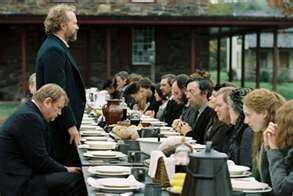
I must begin with a proclamation to all of the smart-asses that may be reading this: Please get over the fact that you figured out the plot-twist before everyone else and stop to appreciate this film. There is no denying that “The Village” is well-acted, gorgeously shot and propelled by an elegant musical score. It is also thematically rich. The film scrutinizes a 19th century community’s struggle to cling to innocence, unadulterated beauty and love, and the painful sacrifices they must make to protect this prelapsarian existence. The members of the village do not venture into the surrounding woods and never have due to an intrinsic fear of creatures known as “the one’s we do not speak of.” There exists a truce between the villagers and these unspeakable creatures, and the townsfolk take ritualistic precautions to hinder their threat; the color red is forbidden, as it attracts them, and sacrifices of meat are given. When Noah Percy, (Adrian Brody) a mentally disabled villager, ventures into the forbidden woods, the creatures begin to infiltrate the village. Their presence is at first unseen; they stealthily enter the village and leave disturbing omens, such as skinned animals. Eventually, they do make quite a terrifying appearance. But even more terrifying than the creatures themselves is the sense of claustrophobia that Mr. Shyamalan creates through the omniscient threat of the surrounding woods.  Even the scenes in broad daylight of the villagers’ communal outdoor meals are fraught with tension and disquiet.

Above all, there is a strong cautionary tale inherent in the “The Village,” and here we have our first plot-twist: as it turns out, the real threat is not a supernatural monstrosity, but a human one. The woodland creatures are a “farce” invented by the founding villagers so that future generations will not venture into the corrupt, impure and violent towns.  The village was established because each founding member has suffered from some heinous human act of violence. Their decision to seclude themselves from the darker side of humanity can be perceived as cowardly, but also admirably ambitious and idealistic. But the true horror of the film is that there is no escape from senseless violence and death. This tragic truth is realized when two of the film’s most innocent characters, Ivy Walker (Bryce Dallas Howard) and Noah Percy (Adrien Brody) become unwitting perpetrators of their own love crimes.

Noah Percy’s character exposes the first blemishes of this supposedly untarnished village, and it is not because he is an outcast or mistreated by the townsfolk because of his mental illness. Noah symbolizes the consequences of being encased by innocence one’s entire life and not being capable of knowing or understanding how to cope with the darks side when it begins to surface. When it becomes known to the villagers that Ivy and Lucius Hunt (Joaquin Phoenix) are in love and are to be married, Noah feels betrayed by Ivy, his best friend, and comes to embody the animalistic, brute anguish of uncontrollable jealousy and repressed sexual desire. He brutally stabs Lucius and leaves him critically wounded, and Ivy demands to go to the towns for medicine. Ivy, who has been blind since birth, learns that the creatures are a fabrication from her father, Edward Walker (William Hurt), who is also the founder of the village. In this way, Ivy alone can venture into the woods without fear or deception.

When Ivy falls into a vast muddy ditch, the “safe” amber colors of her robe become soiled, and even though she knows the creatures are not real, she frantically attempts to wipe away the mud. We now arrive at our second plot-twist, which is actually a plot-twist within a plot-twist—a Russian nesting doll behemoth of a plot-twist: the unspeakable creatures are real! Ivy knows she is being hunted by an “unspeakable” when she can hear it mimicking her movements, which they are rumored to do before they attack. The creature then appears behind her from afar, menacingly still and quiet, cloaked in red, its features indiscernibly black and hollow within a red robe. When Ivy out-wits the creature and leads it straight into the ditch she had fallen into moments before, our plot-twist nesting doll opens its outer shell, and it is revealed that the creature is actually Noah, who has found a hidden costume underneath the floorboards of the room in which he had been sequestered after his crime.

Instead of feeling relief that the creatures are in fact still a farce, the revelation that Noah was masquerading as the creature and stalking Ivy in the woods is even more disturbing for the sexual violence that it implies. If you think I’m reaching too far by suggesting that Noah had intentions of raping Ivy, I’d like to invite you into the realm of yonic imagery. Yonic imagery is basically the feminine version of phallic imagery.  Caves, ditches and small oval openings of any sort are the most common forms of yonic imagery. Yes, Mr. Shyamalan has Ivy fall into a muddy ditch for some cheap suspense, but more tellingly, to augment the sexual confrontation that is about to unfold between Ivy and Noah in the woods.  When Ivy leads Noah straight into this ditch where he falls to his death, it would not be a stretch to say that Mr. Shyamalan is making his own twisted version of a feminist statement.

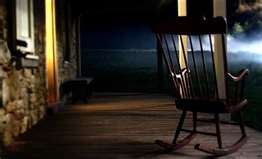
In stark opposition to this violent and sexual turmoil is the presence of delicate, chaste and restrained love.  I watch “The Village” annually around this time of year, and what stirs me every time are the nuanced, intimate and restrained moments that are laced throughout the film. “The Village” certainly has its sensational-verging-on-ridiculous moments, but it also has moments of unassuming solemnity. In one of the film’s most tender scenes, Ivy finds Lucius sitting silently on her front porch at dusk. Even as a young boy, Lucius was drawn to Ivy by a primal instinct to act as her protector, even though, as the film will make clear, she needs none. Just as their heads come together for their first kiss, the camera looks modestly away, instead focusing on an empty rocking chair bathed in mist and twilight.  When Ivy’s older sister decides to marry a man she presumable does not love, there is a brief but telling scene during her wedding in which Ivy embraces her sister. Ivy hugs her sister few beats longer than what may be considered proper, and the camera lingers for its entirety. Ivy’s face is hidden, but we realize that she is not congratulating her sister on her marriage, but thanking her. Now that her older sister is “spoken for,” Ivy is free to pursue her own love—Lucius.

This same subtle elegance is also inherent in Mr. Shyamalan’s script, which is perhaps one of the most mocked elements of “The Village” because its attempt at 19th century colloquialism feels quite forced.  For example, we have mouthfuls like “What manner of spectacle has attracted your attention so splendidly I ought to carry it my pocket to help me teach?”  But we also have quietly devastating lines. Edward Walker and Alice Hunt (Sigourney Weaver) are in love, but cannot fulfill their love because they would be scorned and punished in the confines of their close-knit village. So when Edward sends Ivy to the towns to fetch medicine to save Alice’s son, he tells her, “it is all that I can give you,” and then repeats the phrase with sacred, almost prayer-like finality. Edward wants to give and receive so much more from Alice, but this one act is literally all he is able to give.  And again, when Edward is justifying his decision break the villagers’ oath and send Ivy to the towns: “The world moves for love. It kneels before it in awe.” The first time I watched “The Village,” I was so taken aback by the graceful, unpretentious poetry of that line that I wanted to kneel before it in awe myself.

Perhaps my favorite line of the “The Village” is spoken by Lucius as he reads a letter to the village elders explaining that the creatures will not harm him if he enters the forbidden woods. It is a line that I believe encapsulates the brilliant but flawed film-maker that is M. Night Shyamalan: “They will see I am pure of intention, and not afraid. The end.”  Come back, M. Night! Restore and recapture the earnest and inspired, daring and divisive film-maker you once were.

And no, I will not reveal the final plot-twist. Stop assskiiinng.


Unconventional Love Stories series: ‘Head-On’

“Head-On”: Cahit and Sibel

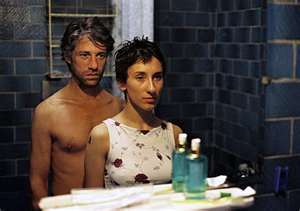
An arranged marriage like no other. Cahit and Sibel meet in a rehab center—he for driving drunk head-on into a cement wall, she for slitting her wrists. Sibel is desperate to marry a Turkish man to appease her traditional Turkish parents and escape from a repressive and often abusive household. Sibel sees the self-destructive, freewheeling Cahit as the perfect match.  He’s Turkish and not looking for any kind of romance or commitment, which will enable Sibel “to live and to dance and to fuck. And not just with one guy.” Sibel proposes this marital “façade” to Cahit, who, after some earnest “what the fuck are you thinking” retorts, accepts Sibel’s proposal. Hence begins one of the most tumultuous, intricate and visceral romances depicted in current cinema.

As husband and wife, Cahit is at first intrigued by –Sibel’s uninhibited sexuality—not towards him, but towards men that Sibel seduces. Cahit’s infatuation grows into jealously as he is left alone in clubs while Sibel “gets laid.” Jealousy grows into protectiveness, and eventually Cahit begins to feel desire and genuine love. Cahit and Sibel’s “marriage” is not sexual, so Cahit’s desire awakens through small intimate gestures, like when Sibel cuts his hair and cooks him a traditional Turkish dinner. We know that Cahit’s a goner when he removes Sibel’s clothes from the hangers, breathes in their scent, and sleeps with them. It is a touching moment, considering Cahit’s coarse exterior.

For me, the most unconventional aspect of Cahit and Sibel’s relationship is how they begin to express their love for each other.  Cahit, in  a love-and-alcohol induced swoon, ecstatically slams both his hands down on a bar table, breaking glasses and bloodying his hands. Oblivious to the pain, he joins the torrent of dancers, raising his arms, dripping blood, over his head and eventually climbing onto the stage in a kind of euphoric victory dance. When Sibel and Cahit are forced apart by circumstances that I refuse to spoil, Sibel cuts her hair boy-short, wears baggy, shapeless clothes and essentially embodies Cahit’s heedless lifestyle. It’s as if the only way she can survive Cahit’s absence is if she becomes him.

The best clip I could find was a mediocre trailer for the film, but at least it gives a pretty clear explanation of the plot. And the Wendy Rene song at the end, “After Laughter (Comes Tears),” gets me every time.


Unconventional Love Stories series: ‘The Piano’

“The Piano”: Ada , Baines and the piano

I first saw bits and pieces of Jane Campion’s “The Piano” when I was very young, maybe ten or eleven. I remember watching the film and wondering, “Why does this man have tattoos on his face?” and “Why is he dusting this piano with his shirt….in the nude?” I recently watched the film in its entirety, and my goodness—it still deserves every bit of praise it received when it was first released in 1993. “The Piano’s” themes, visual beauty and dark humor (yes, it’s funny!) are not in the least bit dated. But I digress. Back to the bizarre love triangle.

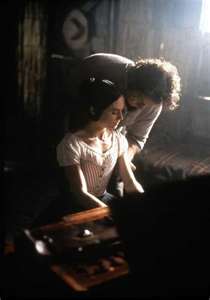
Ada, the mute (by choice), austere and sometimes irascible central character, is in love with her piano. Arriving to New Zealand from her native Scotland, she is no less than a mail-order bride for Stewart, a self-conscious and mundane plantation owner. Baines, Stewart’s friend and sometimes business partner, is at once intrigued and mystified by Ada. Like Ada, Baines too is an outsider; a former Scotland native, he has tribal Maori tattoo markings on his face and has adapted to the Maori culture. After Baines sees Ada literally come alive with joy and passion while playing her piano, he views the piano itself as an opportunity to get closer to Ada. Baines buys the piano and uses it as a contrivance—a pimp, if you will—to bring him and Ada together, as she reluctantly agrees to give him piano lessons at his home. To Ada’s surprise, Baines has no interest in playing himself, and only wants to watch her play. Unable to control his arousal during one of the first “lessons,”  Baines abruptly kisses Ada’s neck while she is playing and reveals to Ada that there are things  he’d “like to do” to her while she plays. Ada is shocked and disgusted, until Baines asks her if she knows how to bargain. He proposes that Ada  “earn” her piano back from him, key by (black) key; that is, each erotic favor Ada allows him is worth the amount of black keys she feels is appropriate.  Caressing her arm while she plays is worth two keys; lying together, naked, is worth ten keys—you get the idea.

I was quite surprised at this plot development because I already knew that Ada and Baines were the romantic center of the film, and I did not expect Baines to force her into something close to prostitution as a prelude to their romance. Yet, as brutish and crude as Baines’ initial “bargain” may appear, his actual erotic advances towards Ada are surprisingly cautious and even tender. During one lesson, Baines asks Ada to lift her skirt higher and higher as he lies on his back underneath the piano bench for an unimpeded view. But instead of the expected groping, his eyes follow her feet as they press on the pedals, and his fingers trace a tiny circle of exposed skin on her leg from a hole in her stocking. Ada, at first prude and aloof towards Baines, slowly becomes intrigued and obsessed with his uncouth and reckless romanticism. Yes, she wants her piano back, but she eventually wants him as well—an eccentric courtship for two very eccentric lovers.

This is a stunning scene which illustrates the unique love triangle between Ada, Baines and the piano. Ada plays the piano while Baines rests his hands on it, feeling its vibrations.  Baines then stares longingly at the  player-less piano, envisioning Ada’s undulating form as it surges and swells over the keys. Unfortunately, the clip ends just before he cleans the piano in the nude with his shirt.


Unconventional Love Stories series: ‘Boys Don’t Cry’

I’m normally not one for lists, but I thought it would be an interesting change to do a short series of my favorite unconventional love stories in film. Each post will be a brief description of a love story in a film and how that love story is extraordinary,  or even unseen, existing beneath subtle layers. I think the love story in my first film, Kimberly Peirce’s “Boys Don’t Cry,” falls into this latter category.

“Boys Don’t Cry”: John Lotter and Brandon Teena

The homoerotic relationship between the transgender Brandon Teena and John Lotter, Lana’s obsessive and frighteningly over-protective ex-boyfriend, is insightfully conveyed through the nuanced eye of director Kimberly Peirce. Brandon initially idolizes John, seeing him as his guide into his new male identity; if Brandon can hold his own alongside John’s ferocious masculinity, he can truly become Brandon. John Lotter’s endearing perception of Brandon as a precocious, often hapless kid brother eventually turns into bewilderment and jealousy. Brandon becomes an object of endless scrutiny for John, who is desperately trying to figure out why Lana chose this slight, effeminate newcomer over him.

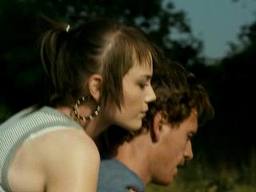
The most erotically charged moment between John and Brandon is when Brandon is blindly driving—more like recklessly speeding—through a dust cloud on a dark Nebraska highway. The film actually begins with a short clip of this moment, because this is Brandon’s ultimate masculine fantasy. Brandon is tentative at first, but is provoked by John, who is sitting, suggestively, directly behind Brandon in the car. This scene in the car is a unique encapsulation of the love triangle between Brandon, John and Lana: Brandon is trying to impress Lana with his reckless masculinity behind the wheel, while John is attempting to maintain his role as alpha-male by expressing his sexual dominance over both Lana and Brandon.  At one point, John leans forward into Brandon from behind, their heads almost touching, and whispers driving directions as he squeezes Brandon’s shoulder. If the dialogue were muted, it would appear as though John was whispering sweet nothings into Brandon’s ear. Brandon presses the gas and revs through the dust, and John slouches into the back seat, clearly experiencing some kind of ecstatic/sexual release, either from the high of the car chase or from the erotic dominant/submissive interplay between himself and Brandon. For the driving-dust-cloud scene described above, fast-foward the below video to 5:51. Or watch the entire clip, which includes one of my favorite lines from Brandon as he checks his good looks in the mirror.

Next up, Ada and Baines in “The Piano.”


Standing still has never been this painful: Miranda July’s ‘The Future’

“The Future” took my breath away. And when I say it took my breath away, I don’t mean to say I was enraptured by its profound insight into “frailty of the human condition,” a much loathed and overused phrase. Instead of being uplifted, I was left with a lump in my throat.  This is because “The Future” does something unprecedented for its art-house, indie-genre: Instead of making light of the characters’ loneliness, desperation and terror through off-kilter humor and oh-so-clever dialogue, it shoves their fears onto the edge of the screen and lets them hang right in front of our noses in all of their pain and discomfort. No matter how hipster or eccentric or unbearably precious Miranda July can be, she is fearless when it comes to unabashedly exposing her fears. In her latest film, July expresses her fear of what the future holds through the claustrophobic paralysis of her characters.

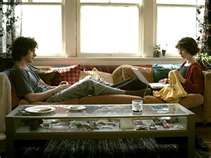
The film begins with a shot of Jason (Hamish Linklater) and Sophie (July) sprawled on a couch, facing each other but looking into their respective laptops.  Jason shifts his position and Sophie asks if he could get her some water. Jason corrects her assumption that he’s getting up and says he’s just changing his position. He doesn’t offer to fetch her water. This evolves into some idiosyncratic verbal interplay between Sophie and Jason, in which they playfully spat over devices and scenarios in which one can obtain water without movement or effort. This seemingly insignificant exchange foreshadows a more profound moment. Earlier in the film, Jason and Sophie choose a song that is a secret code—when the song is played, they will remember themselves and their love for each other.  Sophie, feeling wistful and sentimental, decides that this is the perfect time to play this song and tells Jason to get his IPod.  Jason, only half-heartedly as moved as Sophie, says he’d love to play the song, but the IPod is in his car, and that she can get it if she really wants to hear it. These two people are terrified of moving; whether it’s getting up off the couch, taking an extra trip out to the car, or moving forward through time. “The Future” expresses this dread of inertia, of waiting, of uncertainty, unlike any film I have ever seen.

Jason and Sophie’s comfortable lives drift into unfamiliar territory when they decide to adopt a near-death cat, Paw-Paw. If given enough love and care, Paw-Paw will live a long a prosperous life despite its afflictions. Jason and Sophie, believing their future will be over once they adopt and devote their lives to this cat, decide to live the rest of their lives in the next month before the adoption date. They quit their jobs, turn off the internet and force themselves into feeling the freedom they are seeking. Jason becomes a solicitor for a tree-planting organization; Sophie, a former children’s dance instructor, is determined to perform thirty interpretive dances–“thirty days, thirty dances.”

Just as things seem to be progressing, Sophie and Jason begin to backslide. Inevitably, Sophie and Jason become unsatisfied with their new-found freedom, and regression and immobility take hold. Sophie is especially tormented, so much as to begin an affair with an older, affluent man in suburban Los Angeles named Marshall. Sophie was a nurturing, maternal figure with Jason; even the way they slept together suggested a mother nursing a child. With Marshall, Sophie regresses back to girlhood, and Marshall is turned-on by this girlishness. He asks that Sophie have sex with him and eat ice cream every night, causing Sophie to wake up guiltily grasping an empty ice-cream carton in an empty bed, like a little girl waking up from a sugar-induced sleepover party.

Adding to this already bizarre arrangement is the presence of Marshall’s young daughter, Gabriella. In what I consider the most surreal moment of the film—more so than the talking puppet-cat, voiced by Ms. July herself—is the image of Gabriella digging a hole in the backyard of her house. Later that night, we find her immersed in the soil so that only her curly blonde head is poking out, all smiles. Marshall, too, is all smiles, nonchalantly looking on as his daughter decides to spend the night in a grave which she has dug for herself.  Sophie, however, is unsettled; she stares at Gabriella, mystified, and reassuringly tells her that she can come inside once she gets tired of being entombed in cold dirt. And Gabriella does get tired of it, and also frightened. Sophie wakes up in the middle of the night to find Gabriella in the kitchen, covered in filth and clearly upset. Sophie’s maternal instincts resurface, and in a moment almost too genuine and tender for a quirky Miranda July film, she embraces Gabriella.

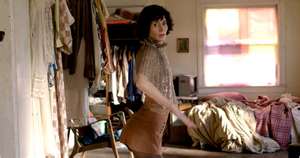
Meanwhile, Sophie is being stalked by her beloved orange t-shirt, which serves as something like a security blanket that she is seen grasping and kneading throughout the film. Every so often, Sophie glimpses it creeping through the house and down the street—not billowing or floating as if carried by the wind, but crawling, as if desperate to be reunited with its owner. Like everyone and everything else in this film, the t-shirt is struggling for movement. When the shirt finally finds Sophie in Marshall’s bedroom, she dons it, and flows into the interpretive dance she’s been waiting to perform for thirty days—thirty dances culminating into one.  Unlike Sophie’s first fledgling forced attempts with a videotape and a neck scarf resembling a lizard’s frill, this dance embodies the organic, effortless movement that’s been eluding her.  She pulls the shirt over hear head so that she is blind to her own gestures, and stretches the shirt so that it consumes her entire body, like a strained womb.

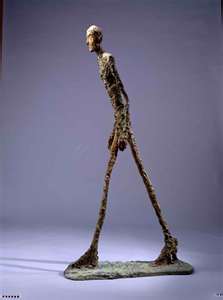
This may be a stretch (pun intended, hell yes), but Sophie’s transformation within the orange shirt—elongated, faceless, even corpse-like—eerily resembles a certain Giacometti sculpture known as “The Walking Man.” Like the characters in this film, “The Walking Man” captures the viscosity and strain of labored movement. Although its legs appear long and capable, his feet are literally blocks of bronze that are affixed to the ground on which he appears to be walking. Sophie, Jason, and even Gabriella, stuck in her dirt hole, are desperate for movement, for change in their own lives, but fear the future so much that they are stuck in a paradoxical push/pull, like “The Walking Man.” Maybe I’ll go to some kind of low-brow culture hell for comparing a Giacometti sculpture to a Miranda July film, but better to reign in a pedestrian hell than serve in an elitist, film-hipster heaven.

In “The Future’s” climactic scene, Jason has successfully stopped time to prevent Sophie from revealing her infidelity to him. He is literally stuck in one place, afraid that if he moves his position just an inch, time will resume, and his life and their relationship will change forever. Jason’s entire body is tense and rigid with the strain of holding onto Sophie, and in his most helpless moment, he turns to the moon outside his window for solace, and asks if it can give him some sort of sign about what is to come.  “I’m just a rock in the sky,” the moon genially replies. Jason and Sophie are not fixed rocks in the sky; they are mutable, even powerful, beings. The film’s ending, though bleak, at least reassures us that time has not stopped for Sophie and Jason. In the final shot, Sophie sits on her bed while Jason reads a book on the couch. For a few long minutes, they are completely still. Just as we begin to wonder whether Jason has stopped time again, he flips the page. At least it’s a relief to know that sometimes, the future and whatever it holds can be as be as ordinary and unremarkable as turning the page of a book.


Why we needed dinosaurs in ‘The Tree of Life’

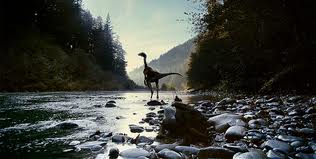
About twenty minutes into Terrence Malick’s “The Tree of Life,” there is a sequence that chronicles the creation of the universe.  There is darkness, then supernovas of stellar light, volcanic eruptions, fire, and  colossal swells of waves and gushing water. Any attempt to describe this with words will not do it justice and I probably just wasted a sentence of my blog.  Once the earth as we have come to know and recognize it has taken shape, we see dinosaurs.  When the first behemoth, a wounded plesiosaur, appears on screen, a woman sitting behind me in the theater said, quite loudly, “We should have gone to the movie next door.”

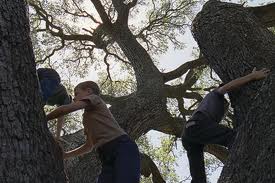
Mr. Malick’s creation interlude, complete with dinosaurs and single-celled amoeba blobs, has been a divisive element of his film among audience members and critics alike. This is mainly because the more conventional 1950s era plotline (done, in typical Malick fashion, unconventionally) is so flawlessly realized.  It follows the coming of age story of Jack (Hunter McCracken) and his relationships with his mother,father and brother.  It conveys the unadulterated vigor of childhood with such boundless joy that at times, it made me want to do nothing more than run; run alongside the boys with their lithe bodies and lanky legs, through the tall grass and the paved streets and underneath the billowing laundry on clotheslines.  It also captured the grief, the inexplicable rage, the fall from innocence in some stunning moments which have been haunting me ever since I saw the film.  The interplay and conflict between these emotions of  pity, rage, fear and compassion as we experience them through young Jack is where the purpose of our dinosaurs is revealed.

Shortly after the disgruntled woman’s unsolicited comment, we are introduced to two more dinosaurs.  I know very little about dinosaurs and am wary about using Wikipedia as a reference, so I will just describe these dinosaurs as medium-sized and raptor-like.  The camera first lingers on a smaller one as it lies in a creek apparently injured and near death.  A larger dinosaur but similar in figure hops toward it, almost playfully. It studies the wounded creature and then forces its clawed foot onto the wounded creatures head, either in an attempt to stomp it to death or suffocate it. Curiously, the predator lets up, and gives its former prey a couple of affectionate taps on the head, and hops away.  I know what you’re thinking, and I’m just as cynical as the next person: “Dinosaurs can’t show affection,”  or  “dinosaurs aren’t noble or compassionate,” or  “c’mon Terrence Malick, gives us some harsh, bloody realism!”  Okay, maybe you weren’t thinking exactly that.  But perhaps you thought the moment was either ridiculous, or, in my case, oddly moving.

I believe the interaction between those two particular dinosaurs serves a vital purpose as the film progresses from prehistory  into young Jack’s narrative.  Yes, young boys in the prime of their youth can be mischievous and even cruel. But through Mr. Malick’s eyes, a child’s fall from innocence is a devastating event.  The way the lens lingers momentarily on images such as a boy’s singed, balding scalp, or a dog with blood matting its fur; the dim lighting, the way the camera slithers in between and around the gang of boys like an unseen snake. The dinosaur’s urge to commit violence is animalistic, but is it also the same bestial urge which influences Jack to commit acts of vandalism, to break into a home, and most disturbingly, to tell his brother to place his hand in front of a BB gun and then pull the trigger? It is certainly valid to say that Jack’s expression of rage is connected to his fraught relationship with his father and that adolescent stalwart known as peer pressure and not from any deep, primal, prehistoric urges. I mean, dinosaurs did not suffer from peer pressure or Oedipal complexes. Or did they….

Even more thought-provoking than young Jack’s expressions of rage is his extreme sense of guilt after he commits or even witnesses other boys committing these acts. Much like the dinosaur’s gentle pats, young Jack, after the BB gun incident, performs silly but kind gestures when he and his brother are alone together in their room. Jack takes a small electric fan and holds it up to his brother’s face in an attempt to cool him off; he curves his lips upward with his fingers in a forced smile.  I can’t recall if Jack actually verbalizes an apology, but his actions speak for themselves, and he does look his younger brother in the face  and tells him, “You’re my brother.”

In “The Tree of Life,” Jack, both young and old, asks questions to some unseen supreme being, questions that are never clearly answered.  Malick’s film does much the same to its audience. What is that confounding flame? How did Jack’s younger brother die? And the query of this essay–why did “The Tree of Life” need dinosaurs? It needed the dinosaurs  so we could ponder yet another question: what is that essence that drives us to commit heinous acts of violence one moment and act compassionately the next? And to propose the possibility that maybe, just maybe, dinosaurs and humans did share some shred of emotional intelligence.  And, even more boldly, to suggest that whatever form of life may succeed us will inherit our emotional intricacies, and hopefully, surpass them.


‘Winter’s Bone’ and ‘Fish Tank’: Cinema’s subtle female avengers

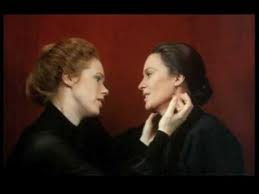
I had recently watched Ingmar Bergman’s all-time-downer-classic, “Cries and Whispers,” for the second time when an article critiquing the latest phenomenon of young, sexualized and violent female characters in film appeared in the New York Times. A.O Scott and Manohla Dargis cite “Kick-Ass,” “Sucker Punch,” and the “Millennium” trilogy as films with young women who express themselves either through superpowers, sexuality, or heinous violence.  In “Cries and Whispers,” film nearly forty years old, I realized that the three sisters essentially express their repressed emotions in almost this same exact manner (save the superpowers, perhaps).  The only difference is that the violence is self-inflicted and the sexuality is merely hinted through gestures, sidelong glances, and the occasional touch and kiss.

My point is that it is possible to convey the “complex intertwinings of sex and violence” without female exploitation and special effects.  Furthermore, we still see examples, few they may be, of young women who assert their power through more multi-faceted and subtle means. Mr. Scott and Ms. Dargis justly but briefly mention these films and characters, I would like to expand on their observations.  Two standout heroines who broke the mold of ass-kicking, gun-slinging girls were Ree in Debra Granik’s “Winter’s Bone” and Mia in Andrea Arnold’s “Fish Tank.”  In “Winter’s Bone,” Ree exudes her power over others—men included—neither through sexuality or violence; her voice barely even raises above a low whisper, save for one crucial moment.  Mia, although a decidedly more brazen presence than Ree, articulates her very fraught emotions through the silence and fluidity of dance.

Both Mia and Ree do share some interesting similarities with the women of “Kick-Ass” and “Sucker Punch,” such as the pattern of what Mr. Scott calls “reassuring and creepy” father figures.  These are men who take young, vulnerable girls under their wing and proceed to sexualize them and/or persuade them into violent action.  Mia perceives Conor, her mother’s boyfriend, as father figure, but is also attracted to him, a fact that Conor eventually takes full advantage of.  What is most disturbing about Ms. Arnold’s depiction of their relationship is that initially, Conor’s actions can be viewed as either extremely inappropriate or utterly innocent.  When Mia falls asleep on the couch, Conor carries her like a baby to her room, lays her on the bed and takes of her pants, only to lift the covers over her legs and up to her shoulders, tucking her in.  The “creepy” factor is definitely there, but also the possibility of a paternal figure.  Ree and Teardrop share a similarly complex relationship, minus the sexual innuendo, although the threat of violence is certainly there at first.  Teardrop is the brother of her missing father, and despite his skinny, hangdog demeanor, he is one scary guy.  We are first introduced to him as he ambles down the staircase of his house, still in his pajamas.  A cup of coffee is placed on the table in front of him and he hunches down and slurps the coffee, hands-free, hinting at his animal tendencies and rage.  When Ree, who has come to inquire about the location of her father, asks one question too many, he lunges out of his chair and grabs Ree by the side of her head, not hitting her, but hurting her all the same. As the film progresses, Teardrop will not only become Ree’s only ally, but the one member of her immediate family aside from her younger siblings who loves and protects her.  These two important male figures in the lives of Mia and Ree prove to be more intricately drawn than the “reassuring or creepy” type that Mr. Scott depicts—they are a disturbing embodiment of both.

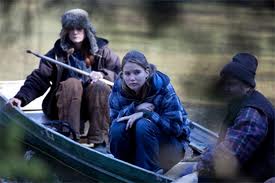
Mia, and even the ever-stoic Ree, also personify the “female rage” that Mr. Scott describes and take their own brand of revenge against abusive men. Mia’s revenge against Conor’s emotional and sexual abuse is especially frightening because she demonstrates that her reckless abandon goes beyond merely head-butting other teenagers.  In a bizarre but terrifying sequence, Mia kidnaps Conor’s daughter, snatching her right off her scooter and forcing her to march to cliffy seashore, where she nearly drowns.  Mia may not take an axe to Conor a la Lisbeth Salander, but she hits him where it hurts the most by invading his personal family life and staining his daughter’s innocence. Speaking of Lisbeth’s revenge on her father,  Ree also, if more symbolically, takes her own form of gruesome revenge on her already dead father not with a axe, but with a chainsaw. Ree is certainly more sympathetic to her absent father, whom she clearly still loves.  So when Ree grasps her father’s dead hands through the murky water in which his body has been dumped, and is handed a chainsaw, which she must use to cut off those hands as proof of his death,  it is a much more grueling and horrifying act than Lisbeth’s attempt at patricide.

The taciturn Ree a stark contrast to the foul-mouthed Mindy/Hit Girl of “Kick-Ass.”  Ree’s might is measured by the force and consequences of her actions and, even more so, by the thoughtfulness of her silence.  She answers every question after a long stretch of painstaking silence; you can almost hear the wheels turning in her head. Ree’s one verbal catharsis is blunt, relentless, and free of expletives.  She stridently bellows the name of the town patriarch—“THUMP MIL-TON!”—over and over again, her cries intermixing with the groaning of the cows of the auction house to where she has tracked him down.  Ree knows she will not get a reaction out of him, but she continues to holler those three syllables with dogged conviction. Ree’s verbal torrent will have grim consequences, and she knows this, and is not afraid.  When it counts, Ree uses her words, and uses them fervently.

With Mia we encounter the opposite trait: a ribald, vituperative and sometimes dangerous teenager who spits out the coarsest obscenities as if it’s her own secret language.  Above all things, Mia is a kinetic being, although her physicality is not of the action-heroine variety, such is the case with the girls of “Sucker Punch.”  An aspiring hip-hop dancer, Mia is constantly in motion, whether practicing moves alone in an empty room of an abandoned high-rise or prowling the dingy, drab streets of her town.  Mia’s physical grace is the reason why her most defining moment in “Fish Tank” is devoid of words altogether.  In a silent but tense moment of alternating confrontation and empathy, Mia and her mother dance together—not side by side, not in a loving mother-daughter embrace, but facing each other, toe-to-toe, an uncanny mirror image:

(Sorry about the weird subtitles)

Ingmar Bergman would beg to differ, but sadly, you need a bit more than cries and whispers nowadays to get by in the movie land of sexed-up-women-with-weapons. So, you foul-mouthed, pre-sexual yet inappropriately erotic superhero; you mercurial, mohawked, axe-wielder; you sword-swinging, scantily-clad prisoners of a misogynistic psycho-ward/alternate reality–Ree and Mia would like you to know that all a girl needs to get by in this cruel world is the good sense to know when to make your voice heard, and some sweet dance moves.  And perhaps, in dire circumstances, to be used only as an expression of deeply repressed female anger and grief, a chainsaw.

Work cited:

Scott, A.O., and Manohla Dargis. “Gosh, Sweetie, That’s a Big Gun.” New York Times 27 April 2011: MT1. Print.


The Danny Boyle Vertus

Oh Danny Boyle, who continues to direct films which leave me slack-jawed, squinty-eyed, and thinking “what in the Christ king just happened here?”  As an ode to you, Danny Boyle, I will conceive of a single word to encapsulate all that is eerie and astounding, shocking and cathartic about your films.  The word is Boylesque. Yes, I know that Mr. Boyle can be over the top with his obsession with sensory stimulation, and that “Slumdog Millionare” was definitely not Oscar-worthy, but the man takes risks.  For me, his most satisfying and successful gambles are the ones in which he jeopardizes losing his audience to the sheer audacity and grandeur of his vision, and his most recent film, “127 Hours” is an example of this.

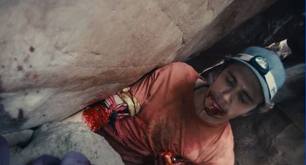
Perhaps a more refined director would opt for not explicitly showing Aron’s act of amputating his arm, complete with the nauseating sound of tendons snapping and bones breaking; they may decide to leave this horrendous act of self-mutilation to be envisioned in the audience’s own imagination.  But Mr. Boyle gives us the complete visceral experience because the pay-off is so cathartic.  When Aron finally cuts through his arm, he literally falls backwards, released from the burden of his own imprisoned flesh. That simple act of Aaron falling away from himself, the complexity of his simultaneous freedom and loss and the mixture of disgust and triumph that we feel may be Boyle’s most poignant “what the fuck” moment thus far.  Below are a few other notable Boylesque moments from “28 Days Later” and “Sunshine.”

What makes a Danny Boyle film Boylesque?
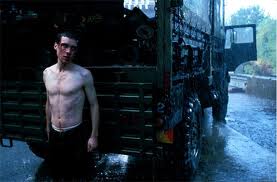
1. Danny Boyle makes films which unfold as if they will never end.  And you never want them to end.
2. His films explore the conflict of Humans vs. Themselves vs. Nature vs. God but ultimately Humans vs. Themselves.
3. As with every film, Danny Boyle’s films always have a crisis.  Except that  Boyle’s crises are of colossal and unfathomably grave proportions.
“28 Days Later:” Crisis=worldwide viral infection which is transforming the human population into rage-induced, blood-spewing versions of their former selves.
“Sunshine:” Crisis= The sun is dying, therefore, we are dying.  Hence the film’s eponymous title.  Oh Danny Boyle, your frankness is another trait to cherish!

The Vertus
Above all, there is the Boylesque “My God, Danny Boyle!!” moment.  This moment usually occurs midway through a Danny Boyle film and is the plot’s turning point, which we  English majors like to fancifully call the vertus.  In Latin, vertus means “turn,” and in literature,  the term describes the turning point in a poem.  If you’ve read Emily Dickinson’s “Because I could not stop for Death,” you know what I’m talking about.  It’s the moment in a poem where what you’re reading veers suddenly towards the shocking, unsettling, and often macabre.

There is a definite vertus that occurs in both “28 Days Later” and “Sunshine,” although the turns go in opposite directions.  For an explanation of both films’ verti (correct Latin plural, sorry if I sound stuck up-think “hippopotami”), please continue reading below.

People Killing People
We already know going into “28 Days Later” that it is a zombie film, so as disturbing and terrifying as this element is, we are not overly surprised when we first encounter the enraged un-dead.  Furthermore, it is completely logical for us to neatly label zombies as the villains of the film.  Thus, the only natural “good guys” of the story must certainly be anyone who is not a zombie.  Enter Jim (Cillian Murphy) and some stray survivors, including a father and his daughter, Hannah, and Selena, a machete-wielding pessimist.
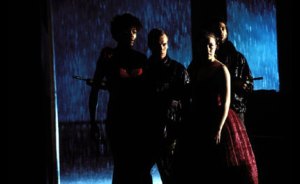
When Jim and friends are “rescued” by an uninfected branch of the British military, our instincts emit the safe signals. That is, until the camera meaningfully lingers on the huge, contorted sculpture of a man with a writhing serpent between his legs that is strategically located at the antechamber of the soldiers’ “safe house.” Another scene that foreshadows the impending vertus  involves a sexually charged soldier lasciviously taunting Selena and Hannah (that Hannah is only 15 years old emphasizes the perversity of the soldier).  Almost as an aside, the captain subtly and secretly warns the soldier not to stop, but to “slow down.”

The vertus lies within the film’s reversal of expectations: the military base becomes a house of horrors for Hannah and Selena as they realize that instead of being eaten alive by zombies, they will be continually tortured and raped by men whom are literally dying for female flesh.   Boyle’s message is that humans don’t need to be infected with a rage virus to harm one another; people have always killed people since the beginning of time, as one philosopher soldier observes.  This notion is by no means a new theme in film, nor in actual life.  But it is Boyle’s precise method of delivery and sense of pacing and suspense that gives this realization such jarring and upsetting power.

And Now for Something Completely Freakish
“Sunshine’s” vertus works in much the same formula as “28  Days Later,” except it takes the plot into completely unexplored territory.  We can thank the character of Pinbacker, a self-made demigod of the Sun, for “Sunshine’s” majestic vertus, which is one of the most (ADJECTIVE ALERT!) shocking, chilling and utterly confounding moments I have ever witnessed on film.

We already have our apocalyptic plot: the death of “our largest star.”  We have our crisis: crew members of the Icarus II are sent to save the Sun and ultimately forced into stoically discussing which crew members to kill off in order survive on limited oxygen.  But, unlike “28 Days Later” where the vertus spins us from the sensational premise of zombies to the mundane horror of sexually desperate military men, “Sunshine” steers from the rational effects of nature  (humans killed the sun, are forced to kill each other) to  nature’s sensational effect on one man: Pinbacker, the once human captain of the failed Icarus I mission, now a demon of the sun.  And it is Boyle’s vision of Pinbacker which makes “Sunshine’s” vertus so sensational, and even supernatural.

Unlike the realism of the soldiers’ situation in “28 Days Later,”,  Pinbacker’s human form has transformed into an entity that is other-worldly (literally) due to intense and obsessive self exposure to the Sun.  Our fist glimpse of him is through the eyes of Kapa (Cillian Murphy), engulfed in a white light so bright that we are squinting, unable to discern whether the form is human or alien.  Next, we hear Pinbacker breathing; shallow, wet, raspy gasps which give the impression that he’s inhaling his own melting insides.  As Kapa approaches close enough to discern that the horrifically burned figure is human, the unbelievable truth finally dawns on him:

Kapa: “My God….my God…..Pinbacker.”
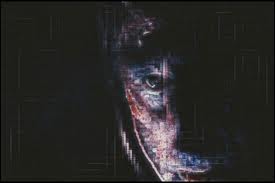
Pinbacker: “Not your God.  Mine.”

In those nine words we have our “what in the Christ-King is going on heeeerrrrre!?” moment; in other words, our Boylesque vertus.

The first time we have an honest to God  look at Pinbacker is through a glass window on a closed door.  His hand rests on the door, very much human, except nothing is left but scarred, bloody, raw flesh.  In contrast, his face is indiscernible; it jitters and stretches, possessed with some kind of stellar energy.  His sun-scarred eyes, however, remain focused amidst the chaos of the rest of his body, his gaze searing through the window.   Boyle’s haunting image of Pinbacker, a man driven mad by the inescapable omnipotence of the Sun, is more horrifying than the pure rage and raw bloodiness of “28’s” zombies.  Why is it so horrifying?  Because, like the soldiers,  Pinbacker is human.

In all respects, Danny Boyle is a fearless film maker. He isn’t afraid to unearth the disturbing fact that even in a world free of zombies, of natural disasters, of global warming, humans are still left with the primal fear of each other. He places a mirror in our faces and asks, “Scared yet?”  And that is what’s truly terrifying.

Oh, Danny Boyle, thanks for the pick me up!

‘Let Me In’: In the name of young love

I scarcely remember grinning as much during a film as I did while watching “Let Me In.” Grinning during a horror movie, you ask?  Allow me to explain. It was an all-encompassing smile of pleasure, joy, satisfaction, surprise, and a little bit of awe at how carefully and reverently this film was adapted by American director Matt Reeves in homage to its Tomas Alfredson’s Swedish original, “Let the Right One In.”  This gratifying experience could be compared to listening to a faithful and moving interpretation of a favorite symphony or an innovative cover of a cherished song: all of the basic foundations that made the original remarkable are still there, but with subtle and sometimes inspired variations.  Needless to say, I could not wipe the stupid smile off my face.

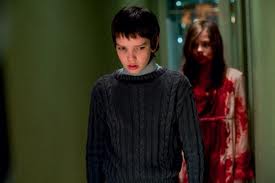
The story centers on Owen (Kodi Smit-McPhee), a boy whose diminutive, scrawny frame and uncannily pallid complexion make him an easy target for bullies at school, one of whom is especially brutal. Only Abby (Chloe Moretz), his new young neighbor whom he bonds with over a rubix cube, is aware of Owen’s plight and offers to help him. While Abby and Owen become increasingly intimate, his mother is oblivious to the physical wounds Owen suffers from his tormentors, while his father is reduced to a detached voice on the phone. This impending separation between the realms of childhood and adulthood is made painfully clear when Owen calls his father on the phone.  Owen’s genuine fear and confusion over the possibility that Abby may indeed be “evil” eludes his father, who turns the conversation into another reason to vent his anger towards Owen’s mother. It is a devastation but liberating moment for Owen as he realizes he is on his own—that is, unless he has the mettle to “let the right one in”—even if “the right one” can’t share his sweet tooth and has been “twelve for a very long time.”

As with any remake, especially an American remake of a foreign film, there are moments of what I would call “American exposition”—when certain plot points or emotions are made blatantly clear instead of subtly implied. An example of “American exposition” occurs during one of the film’s most jarring but tender scenes. Owen, apprehensive about Abby’s “evil” intentions after discovering she is a vampire, refuses to invite her into his home.  In spite Abby’s supernatural abilities and strength, Owen realizes he is the dominant in this situation and flaunts his power, taunting her with clicking sounds as if she’s an animal, mocking her inability to act for herself without his permission. Finally, Abby passes through the doorway, uninvited. After a tense moment, Abby begins to quietly tremble as blood purs from her eyes, mouth, even her heart.  Owen, frightened and disgusted by his own brand of bullying, embraces her and invites her in. In the American version, Abby tells Owen that she knew he wouldn’t let her die; in the Swedish version, Eli says no such thing—her absolute trust in him is implied by her perilous crossing of the threshold.  It is a slight and perhaps even inconsequential variation from the original, but it would be reassuring to think that American audiences would grasp the emotional bond between these two companions without such a deliberate verbal cue.  Nevertheless, this and other instances of “American exposition” do not lessen the film’s loyalty to the original nor does it diminish the emotional intricacies that exist between Abby and Owen.

“Let Me In” is a coming of age story about a child’s loss of innocence in realizing that parents and grownups offer little if no protection or guidance; an adolescent vampire story that is mercifully free of the sexual charge and baroque love triangles of the “Twilight” saga.  “Let Me In”  instead thrives on the unique bond as it forms between two young friends, each with the power to help the other. Ever faithful to Alfredson’s original vision, Reeve’s beautifully choreographed end sequence in a swimming pool encapsulates the film’s central paradox of innocent love and the ghastly violence committed in the name of that love.  Before I start straying into the lyrics of a certain U2 song, I will say that in “Let Me In,” bloodshed for the sake of friendship never felt so right.