Tag Archives: Jessica Chastain

‘Take Shelter’

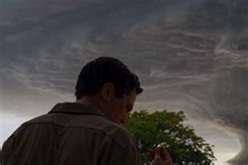
Haunting, unsettling, terrifying, anxiety-inducing—you name the adjective and it’s been used to describe Jeff Nichols modern day apocalyptical masterpiece, “Take Shelter.” So what more is there to say? “Take Shelter” is indeed all of the above, and the brilliance of the film is that it is so understated that you don’t realize or understand its impact until it has had time to settle under your skin and into your psyche.

It is always a challenge to watch a movie in which the expectations have already been set sky high. Oftentimes, when experiencing any art form that has garnered a wealth of critical praise, I find that I am forcing myself to feel certain emotions and be moved in some meaningful way by the art. The feeling is not genuine, but rather what I think I am expected to feel. This does not happen often, but it is extremely disappointing when it does. And to be honest, I was forcing myself to feel unsettled and disturbed early on in “Take Shelter,” when the images of Curtis’ (Michael Shannon) nightmares begin to unfold. I had read so many articles describing the eeriness of these dreamlike events that I felt desensitized to them; the ribbon-like formations of the birds, the churning black clouds, the rust-colored rain. I was on the verge of a glorious let-down when a tall drink of water and force of nature that surpasses the portentous storm named Michael Shannon pulled me out of my disenchanted stupor.

Shannon’s restrained performance as the anguished everyman-prophet was the most distressing element of the film, more so than the impending unknown terror of his nightmares and visions. To see Shannon, who is 6’3, give such a physically and emotionally internalized performance was a spectacle in itself. During a particularly intense episode, Curtis suffers so viscerally from a nightmare in his sleep that his wife, Samantha (the omnipotent Jessica Chastain, and welcomingly so) fears he is having a stroke and dials 911. It is an agonizing scene to watch because of the vulnerability of both Curtis and Samantha, who has thus far been kept in the dark about her husband’s inner torment. Scenes such as this heighten “Take Shelter” from a doomsday thriller to a sensitively rendered domestic drama.

“Take Shelter” has garnered praise for being a painfully realistic cautionary tale for our own demise. Curtis’ troubling visions represent our own very real financial and environmental apocalypse, and the fact that Curtis is sane enough to question his own insanity makes his prophecies all the more tangible. But Mr. Richards’ nuanced and natural depiction of the family’s bond and dynamic in the midst of Curtis’ struggle gives the film its heart. There are  crucial and surprising moments in which Samantha does not shun Curtis for his possible psychosis. In one scene, when Curtis finally unleashes his turmoil in a bout of hysteria during a Lion’s Club dinner, Samantha does not walk out on him with her daughter, but, at the risk of becoming an outcast in her community, embraces him, and the three leave together in a display of unconditional love and solidarity. At risk of spoilers, I will not describe anymore such scenes, but I will say that the interaction between Curtis and Samantha, and the realm of emotions that they can convey with so few words, was, like the film itself, quietly breathtaking.

Why we needed dinosaurs in ‘The Tree of Life’

About twenty minutes into Terrence Malick’s “The Tree of Life,” there is a sequence that chronicles the creation of the universe.  There is darkness, then supernovas of stellar light, volcanic eruptions, fire, and  colossal swells of waves and gushing water. Any attempt to describe this with words will not do it justice and I probably just wasted a sentence of my blog.  Once the earth as we have come to know and recognize it has taken shape, we see dinosaurs.  When the first behemoth, a wounded plesiosaur, appears on screen, a woman sitting behind me in the theater said, quite loudly, “We should have gone to the movie next door.”

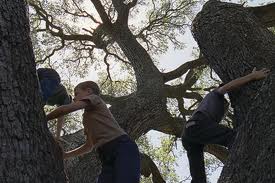
Mr. Malick’s creation interlude, complete with dinosaurs and single-celled amoeba blobs, has been a divisive element of his film among audience members and critics alike. This is mainly because the more conventional 1950s era plotline (done, in typical Malick fashion, unconventionally) is so flawlessly realized.  It follows the coming of age story of Jack (Hunter McCracken) and his relationships with his mother,father and brother.  It conveys the unadulterated vigor of childhood with such boundless joy that at times, it made me want to do nothing more than run; run alongside the boys with their lithe bodies and lanky legs, through the tall grass and the paved streets and underneath the billowing laundry on clotheslines.  It also captured the grief, the inexplicable rage, the fall from innocence in some stunning moments which have been haunting me ever since I saw the film.  The interplay and conflict between these emotions of  pity, rage, fear and compassion as we experience them through young Jack is where the purpose of our dinosaurs is revealed.

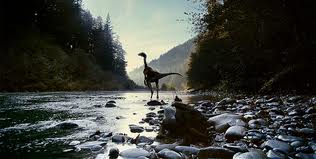
Shortly after the disgruntled woman’s unsolicited comment, we are introduced to two more dinosaurs.  I know very little about dinosaurs and am wary about using Wikipedia as a reference, so I will just describe these dinosaurs as medium-sized and raptor-like.  The camera first lingers on a smaller one as it lies in a creek apparently injured and near death.  A larger dinosaur but similar in figure hops toward it, almost playfully. It studies the wounded creature and then forces its clawed foot onto the wounded creatures head, either in an attempt to stomp it to death or suffocate it. Curiously, the predator lets up, and gives its former prey a couple of affectionate taps on the head, and hops away.  I know what you’re thinking, and I’m just as cynical as the next person: “Dinosaurs can’t show affection,”  or  “dinosaurs aren’t noble or compassionate,” or  “c’mon Terrence Malick, gives us some harsh, bloody realism!”  Okay, maybe you weren’t thinking exactly that.  But perhaps you thought the moment was either ridiculous, or, in my case, oddly moving.

I believe the interaction between those two particular dinosaurs serves a vital purpose as the film progresses from prehistory  into young Jack’s narrative.  Yes, young boys in the prime of their youth can be mischievous and even cruel. But through Mr. Malick’s eyes, a child’s fall from innocence is a devastating event.  The way the lens lingers momentarily on images such as a boy’s singed, balding scalp, or a dog with blood matting its fur; the dim lighting, the way the camera slithers in between and around the gang of boys like an unseen snake. The dinosaur’s urge to commit violence is animalistic, but is it also the same bestial urge which influences Jack to commit acts of vandalism, to break into a home, and most disturbingly, to tell his brother to place his hand in front of a BB gun and then pull the trigger? It is certainly valid to say that Jack’s expression of rage is connected to his fraught relationship with his father and that adolescent stalwart known as peer pressure and not from any deep, primal, prehistoric urges. I mean, dinosaurs did not suffer from peer pressure or Oedipal complexes. Or did they….

Even more thought-provoking than young Jack’s expressions of rage is his extreme sense of guilt after he commits or even witnesses other boys committing these acts. Much like the dinosaur’s gentle pats, young Jack, after the BB gun incident, performs silly but kind gestures when he and his brother are alone together in their room. Jack takes a small electric fan and holds it up to his brother’s face in an attempt to cool him off; he curves his lips upward with his fingers in a forced smile.  I can’t recall if Jack actually verbalizes an apology, but his actions speak for themselves, and he does look his younger brother in the face  and tells him, “You’re my brother.”

In “The Tree of Life,” Jack, both young and old, asks questions to some unseen supreme being, questions that are never clearly answered.  Malick’s film does much the same to its audience. What is that confounding flame? How did Jack’s younger brother die? And the query of this essay–why did “The Tree of Life” need dinosaurs? It needed the dinosaurs  so we could ponder yet another question: what is that essence that drives us to commit heinous acts of violence one moment and act compassionately the next? And to propose the possibility that maybe, just maybe, dinosaurs and humans did share some shred of emotional intelligence.  And, even more boldly, to suggest that whatever form of life may succeed us will inherit our emotional intricacies, and hopefully, surpass them.